
Check three things before you call anyone: is the boiler powered on, is there a fault code showing, is the thermostat set correctly with fresh batteries, and does the pressure gauge read within the normal range. If you smell gas, hear a carbon monoxide alarm, or notice soot around the unit, evacuate immediately and call 911 and your gas company. Otherwise, work through the safe checks below. If the boiler still won't heat after that, it's time to schedule a licensed diagnostic.
TL;DR:
- Most boiler heating issues stem from simple causes like low pressure, electrical faults, or thermostat problems that homeowners can address themselves.
- Maintaining boiler pressure between 1 and 1.5 bar and bleeding radiators can resolve many no-heat complaints without professional help.
- If the boiler still won't heat after safe checks, symptoms such as persistent low pressure or repeated fault codes indicate the need for licensed diagnostic and repair.
- Safety concerns like gas leaks, unusual smells, or visible soot require immediate evacuation and calling emergency services; do not attempt to troubleshoot those issues yourself.
- Routine maintenance, pressure monitoring, and insulation prevent most future breakdowns, especially in boilers over 10 to 15 years old.
Table of Contents
- Why Is My Boiler Not Heating? Start With These Safe Checks
- How Do You Check and Fix Low Boiler Pressure?
- Why Are My Radiators Not Heating Evenly?
- Heating Works but No Hot Water: Is It the Diverter Valve?
- Could a Pump or Heat Exchanger Be the Real Problem?
- What If the Condensate Pipe Has Frozen?
- When Does a Boiler Problem Become a Safety Emergency?
- When Should You Call a Licensed Boiler Technician?
- How Can You Prevent Future Boiler Breakdowns?
- What 38 Years of Boiler Calls Have Taught Us
- Get Your Boiler Back to Full Heat, Fast
- Sources
- FAQ
Why Is My Boiler Not Heating? Start With These Safe Checks
Most "boiler not firing" calls trace back to something simple. Before you assume the worst, rule out the basics.
- Power supply: Confirm the boiler is switched on at the fused spur, and that the display panel is lit and active.
- Circuit breaker: Check your electrical panel. If the breaker tripped, reset it once. Repeated tripping means an electrical fault, not a fluke.
- Thermostat settings: Make sure it's in heating mode with the setpoint several degrees above room temperature. Swap batteries in wireless thermostats even if they look fine. Weak batteries cause more no-heat calls than homeowners expect.
- Fault codes: Look at the display for an error code. Consult your manual and attempt one reset. If the same code returns, stop resetting and call a technician. Repeated resets can mask a developing fuel or ignition problem.
These four checks resolve a surprising share of "why is my boiler cold" complaints without a service call.
How Do You Check and Fix Low Boiler Pressure?
A boiler that won't fire because of pressure is one of the most common issues homeowners run into, and one of the easiest to check yourself. Normal cold pressure typically sits between 1 and 1.5 bar, and most boilers refuse to ignite once the gauge drops meaningfully below that.
- Locate the pressure gauge, usually on the front panel or beneath the boiler casing.
- If the needle sits below the recommended range, find the filling loop, a flexible braided hose connecting the boiler to the cold water supply.
- Open the valves slowly, watching the gauge climb, and close them the moment you hit the target reading.
- Bleed off any overshoot the same way you'd release air from a bike tire.
Pro Tip: Do this once. If pressure creeps back down within a day or two, you're not dealing with a one-time fluke. That pattern almost always points to a leak somewhere in the system or a failing expansion vessel, and topping it off repeatedly just masks the real problem. A diagnostic visit for a persistent pressure drop typically runs $80 to $250, depending on how far the technician has to dig.
Why Are My Radiators Not Heating Evenly?
Trapped air is the classic cause of a radiator that's warm at the bottom and stone cold at the top. It's also one of the few boiler-adjacent problems you can fix in under ten minutes with a radiator key.
- Turn the heating off and let the system cool before you start.
- Hold a cloth and small container under the bleed valve at the top corner of the radiator.
- Turn the valve slowly with the key until you hear a hiss of escaping air.
- Close it the instant water starts to dribble out steadily.
- Repeat on every radiator with a cold-top, warm-bottom pattern.
If the water that comes out looks dark, rusty, or sludgy rather than clear, stop there. That's a sign of internal corrosion, and bleeding won't fix it. You'll want a professional powerflush to clear the buildup before it damages the pump or heat exchanger.
Pro Tip: Always recheck the pressure gauge after bleeding radiators. Releasing air also releases a bit of water, and the pressure often dips just enough to need a small top-up.
Heating Works but No Hot Water: Is It the Diverter Valve?
If your radiators are warm but the taps run cold, the fault usually isn't your boiler's ability to make heat. It's a stuck diverter valve, the component inside a combi boiler that switches flow between the central heating loop and the domestic hot water circuit.
When it sticks in the "heating" position, hot water never reaches the tap even though the rest of the system runs fine. Signs include lukewarm or cold water at every faucet while radiators heat normally, or water that runs hot briefly and then turns cold.
Before assuming the worst, check your hot water temperature dial (it's easy to accidentally turn down), and run a tap at full flow for a minute since low flow rates can trick some flow sensors into staying idle.
- Confirm the hot water dial isn't set too low.
- Run a tap fully open for 60 seconds to see if flow improves.
- Try a full power cycle reset per your manual.
If none of that helps, the valve or its internal flow sensor likely needs replacement. That's an internal-component job requiring a licensed technician, usually landing somewhere between a few hundred dollars and just over a thousand, depending on the part.
Could a Pump or Heat Exchanger Be the Real Problem?
Sometimes the boiler fires up fine, but heat never makes it to the radiators. That points toward the circulation pump or, less often, a struggling heat exchanger.
- Pump failure signs: The boiler runs, but radiators stay cold, you hear humming or grinding from the pump housing, or the pipework right next to the boiler feels hot while pipes further away stay cool.
- Kettling: A banging, whistling, or popping sound coming from the boiler usually means limescale or sludge has built up around the heat exchanger, restricting water flow and causing localized overheating.
- Escalating noise: Louder or more frequent kettling over a few weeks is a sign the blockage is getting worse, not settling down.
None of these are homeowner repairs. Repairs involving pumps or heat exchangers typically involve professional service with costs varying by situation.
What If the Condensate Pipe Has Frozen?
A frozen condensate pipe is one of the most common cold-weather causes of a boiler lockout, and it's also one of the safest fixes for a homeowner to attempt.
- Find the condensate pipe, a white or gray plastic pipe running from the boiler to an outside drain, and check for ice or a lockout code referencing condensate or drainage.
- Pour warm (never boiling) water over the frozen section, or wrap it in towels soaked in warm water. Boiling water can crack the plastic pipe.
- Once thawed, reset the boiler per the manual and confirm it fires normally.
- For prevention, insulate the exposed section of pipe with foam lagging, or ask a technician about rerouting it internally or adding trace heating for repeat offenders.
If the pipe freezes every cold spell despite insulation, that's a design issue worth having a pro correct permanently.
When Does a Boiler Problem Become a Safety Emergency?
Some symptoms aren't troubleshooting opportunities. They're warning signs that mean stop everything and get out.
If you smell gas, hear a carbon monoxide alarm sound, or see soot around the boiler casing, turn the unit off if it's safe to do so, evacuate the house, and call 911 and your gas company immediately. Do not attempt to diagnose the cause yourself.
Never open the combustion chamber, adjust a gas valve, or touch wiring near the igniter. These are licensed-only tasks, and tampering with them can turn a fixable fault into a dangerous one. A yellow, flickering flame or a persistent burning smell also signals incomplete combustion and rising carbon monoxide risk, which calls for immediate professional shutdown and inspection, not a wait-and-see approach.
When Should You Call a Licensed Boiler Technician?
Some faults simply live past the point where a homeowner should keep going. Call a pro once you're dealing with:
- Water leaking from the boiler casing or nearby pipework.
- Repeated lockouts after a single reset attempt.
- Suspected internal component failure (pump, diverter valve, control board, heat exchanger).
- Any smell of gas or visible soot.
Most diagnostic visits fall in the $80 to $250 range, with simple part swaps like an igniter or thermocouple often running a few hundred dollars total, and major component failures climbing past $1,000. Before the technician arrives, have your boiler's make and model, any error codes you've seen, and your last service date ready. When you're on the phone, ask about their license and insurance, what tests they plan to run, whether repair or replacement makes more sense for your unit's age, and get a written estimate before work starts.
How Can You Prevent Future Boiler Breakdowns?
A little routine attention goes a long way toward keeping your system out of emergency territory.
- Schedule one annual professional service to catch wear before it becomes a lockout.
- Check the pressure gauge monthly, especially heading into winter.
- Bleed radiators each fall before the heating season ramps up.
- Insulate any exposed condensate pipe before the first freeze.
- Ask your technician about an inhibitor or magnetic filter, especially if you're dealing with hard water, since scale buildup is what drives kettling and heat exchanger strain.
If your boiler is past the 10 to 15 year mark or you've had more than one major repair in a season, replacement often costs less over time than chasing the next failure.
What 38 Years of Boiler Calls Have Taught Us
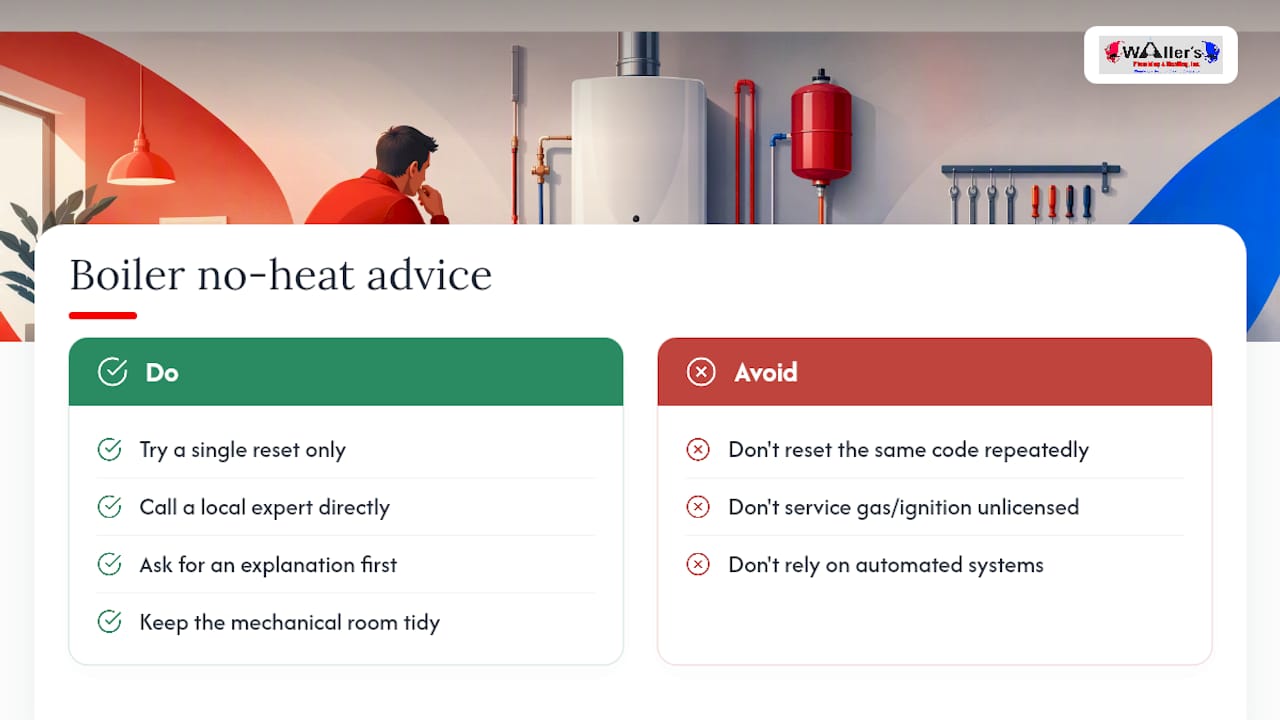
Most no-heat calls we get at Waller's Plumbing and Heating, Inc. share a pattern: a homeowner caught the symptom early, tried resetting the same fault code three or four times, and made the problem harder to diagnose by the time we arrived. A single reset is a reasonable troubleshooting step. Repeated resets or attempts to service gas or ignition components without proper licensing are unsafe. Those parts are built to be serviced by someone licensed for exactly that work.
What we emphasize on every visit is straightforward: you talk to a local expert directly, not an automated system, we explain what's actually wrong before touching anything, and we leave your mechanical room as clean as we found it.
— Aaron Waller, General Manager
Get Your Boiler Back to Full Heat, Fast
If you've worked through the checks above and your boiler still isn't producing heat, it's time for a diagnostic visit instead of another reset. Waller's Plumbing and Heating, Inc. sends a local technician directly to your door, no automated phone tree, no runaround, just a straight answer about what's wrong and what it'll cost to fix.
Our team handles the full range of boiler issues covered here: pressure problems, stuck diverter valves, pump and heat exchanger repairs, frozen condensate lines, and the annual service that keeps most of these calls from happening in the first place. We'll also insulate exposed pipework and install inhibitors or filters if hard water is working against your system.
If your radiators are cold, your pressure won't hold, or your boiler keeps locking out, schedule a diagnostic visit and get a clear, written estimate before any work begins.
Sources
- Boiler maintenance & troubleshooting | Carrier Residential
- How to troubleshoot a boiler with no hot water | HVACDatabase
- Boiler operating defects and safety warnings | Inspectapedia
FAQ
Why Is My Boiler Running but No Heat?
The boiler is likely firing but failing to circulate heat, often due to trapped air in the radiators, a struggling pump, or a stuck diverter valve sending water to the wrong circuit. Low system pressure can also prevent proper circulation even when the burner ignites normally.
How Do You Fix a Boiler That Is Not Heating?
Start with the safe checks: confirm power, verify thermostat settings and batteries, check the pressure gauge reads within the normal 1 to 1.5 bar range, and bleed any radiators with cold spots. If those steps don't resolve it, the fault is likely internal and needs a licensed technician.
What Is the Most Common Boiler Fault?
Low system pressure and trapped air in radiators are among the most frequent causes of a no-heat complaint, and both are safe for homeowners to check and often fix themselves. Diverter valve failures and limescale buildup around the heat exchanger are also common, but those require professional repair.
Why Is My Boiler Heater Not Coming On?
Check the power supply and circuit breaker first, since a tripped breaker or disconnected fused spur will stop the boiler from starting at all. If power looks fine, look at the display for a fault code and check the thermostat setpoint before assuming a deeper mechanical issue, and schedule a diagnostic with Waller's Plumbing and Heating, Inc. if the problem persists.