
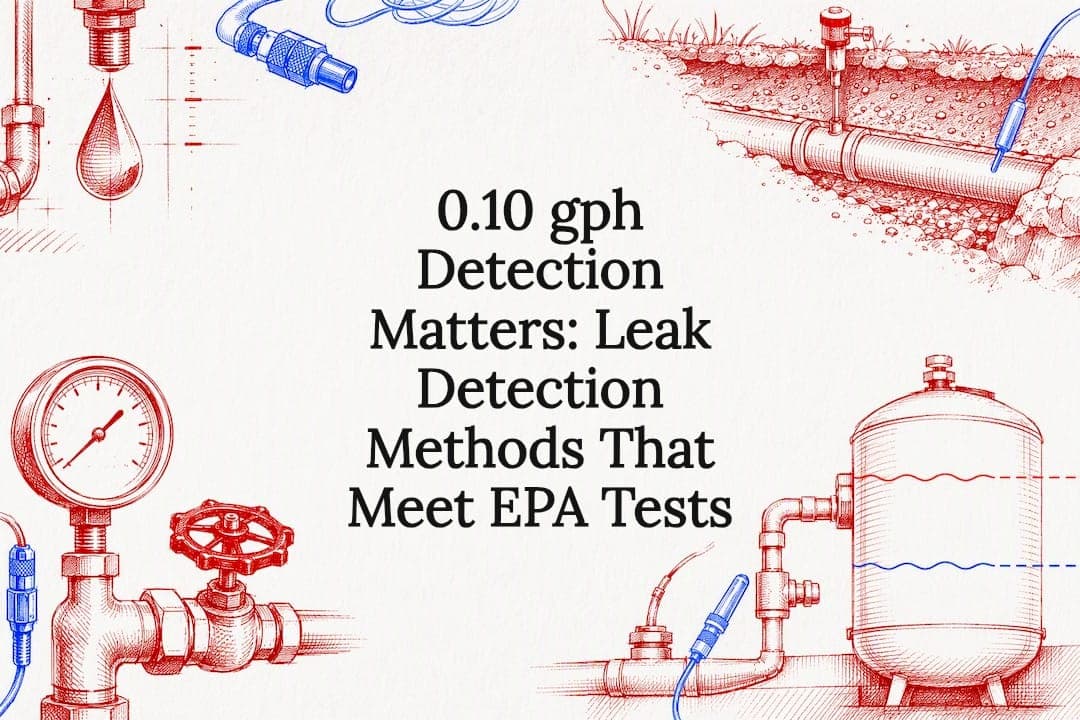
Acoustic and ultrasonic listening find buried water lines and slab leaks. Tracer gas pinpoints small, hard-to-reach leaks in tight spaces. Thermal imaging spots hidden moisture behind walls. Pressure and vacuum decay testing rules on tanks and pipelines, and flow monitoring watches your whole home around the clock. Tanks and pipelines fall under strict EPA performance standards, while household and HVAC leaks give you more flexibility to combine methods based on budget and access.
TL;DR:
- Small leaks are best detected early by point-of-use moisture sensors placed at high-risk appliances for quick notification.
- Acoustic listening is effective for buried or slab leaks but requires trained technicians and can be impacted by environmental noise.
- For large pipelines or underground tanks, continuous monitoring systems like acoustic emission or computational pipeline monitoring meet strict EPA standards and provide real-time data.
- Choosing the right method depends heavily on asset type, access, leak size, and budget, with hybrid systems often offering the best overall detection capability.
- Initial homeowner steps, such as checking the water meter and performing toilet dye tests, are low-cost and help verify the presence of a leak before professional diagnostics.
Table of Contents
- An Overview of Leak Detection Methods and How to Pick One
- Finding a Water Leak in Your Home: Where to Start
- HVAC and Refrigerant Leak Detection: What Actually Works
- Pipeline and Tank Leak Detection: Regulated Tests and Real Thresholds
- Comparing Leak Detection Methods Side by Side
- How to Choose the Right Leak Detection Approach
- A Field Perspective on Diagnosing Leaks Without Guesswork
- Where Leak Detection Technology Is Headed
- Let Waller's Plumbing and Heating Track Down Your Leak
- Sources
- FAQ
An Overview of Leak Detection Methods and How to Pick One
Every leak detection method trades off the same four things: how small a leak it can catch, how much it disrupts your property, what it costs, and how fast it delivers an answer. Understanding those trade-offs before you pick a method saves you money and, in the case of a slow slab leak, potentially thousands of dollars in structural damage.
Here's how the major families break down in plain terms:
- Acoustic and ultrasonic detection listens for the hiss or rush of escaping fluid or gas through specialized microphones and sensors, often correlating sound between two points to triangulate a leak's location.
- Tracer gas detection injects a harmless, detectable gas (often hydrogen or helium blends) into a system and uses a sensitive sniffer to find where it escapes.
- Thermal and infrared imaging reads surface temperature differences caused by moisture evaporation, refrigerant loss, or hot water migrating into cool building materials.
- Pressure and vacuum decay testing pressurizes or evacuates a closed system, then measures how quickly it loses that pressure over time.
- Bubble and dunk testing applies a soap solution or submerges a component to visually confirm a leak's exact location.
- Flow and consumption monitoring tracks water or fluid movement through a system in real time, flagging unusual patterns that suggest a leak.
- Computational pipeline monitoring (CPM) uses software algorithms analyzing pressure, flow, and temperature data across a pipeline network to infer a leak without direct physical inspection.
- Acoustic emission (AE) monitoring places sensors along buried infrastructure to continuously "listen" for the stress waves a developing leak produces.
- Visual and video inspection uses cameras, borescopes, or drain-line scopes to physically see damage, corrosion, or active seepage.
Sensitivity matters most when the leak is small and slow, like a hairline crack in a slab foundation. Invasiveness matters when you can't afford to dig up a yard or shut down a production line to find out what's wrong. Cost and expertise often decide the question for homeowners outright. A $30 moisture sensor from a hardware store solves a different problem than a $15,000 acoustic emission monitoring system on a municipal water main, and neither is the "wrong" choice for its context.
This is also where point-of-use, point-of-entry, and hybrid systems come into play, especially for household water leak detection. A point-of-use device is a small sensor placed under a specific appliance, like a water heater or dishwasher, that alarms when it senses moisture at that exact spot. A point-of-entry system installs at the main water line, using flow monitoring to track every gallon that enters your home and flag abnormal usage patterns that suggest a leak anywhere in the system, not just at one appliance.
Hybrid systems combine both approaches, often adding an automatic shutoff valve that closes the main line the instant abnormal flow is detected. According to EPA WaterSense guidance, these combined sensor-and-shutoff setups are particularly valuable for vacation homes or properties that sit unoccupied for stretches of time, where a slow leak could otherwise run undetected for weeks. If you're weighing a whole-house filtration upgrade alongside leak protection, it's worth looking at how smart monitors and shutoff valves fit into a broader water system plan.
The right starting point almost always depends on scale. A single dripping faucet doesn't need acoustic correlation equipment. A commercial pipeline spanning miles of buried infrastructure can't rely on a homeowner's moisture puck. Match the method to the asset, not the other way around.
Finding a Water Leak in Your Home: Where to Start
Most homeowners jump straight to worrying about slab leaks or hidden pipe failures, but the sequence that actually works starts much simpler. Skipping steps wastes money on professional diagnostics you may not need yet.
Pro Tip: Before calling anyone, check your water meter. Turn off every fixture and appliance in the house, note the meter reading, wait 30 minutes without using any water, and check it again. If the number moved, you have a leak somewhere in the system, even if you can't see or hear it.
Here's the practical order of operations for tracking down a hidden water leak:
- Isolate at the meter. The test above tells you whether a leak exists before you spend a dime on equipment or a service call.
- Run the food-color toilet test. Toilets are the single most common source of silent water waste in a home. Drop food coloring into the tank, wait 10 minutes without flushing, and check the bowl. Color in the bowl means your flapper valve is leaking, a fix that costs under $20 and takes 15 minutes, according to EPA WaterSense guidance.
- Do a visual walkthrough. Check under sinks, around the water heater base, near the washing machine hookup, and along exposed basement or crawlspace pipes for staining, corrosion, or dampness.
- Deploy moisture sensors at high-risk points. Small battery-powered detectors placed directly underwater heaters, washing machines, and dishwashers catch leaks the moment they start, long before they become visible damage. Placement matters here: put the sensor at the lowest point of the appliance's footprint, since water pools there first.
- Consider a point-of-entry flow monitor if the meter test came back positive but nothing visible turned up. These ultrasonic or magnetic flow devices clamp onto or install into your main water line and track consumption patterns 24/7, alerting you to anything that looks like a running toilet, a burst pipe, or a slow slab leak you'd otherwise never notice.
- Escalate to acoustic listening for buried or slab leaks. A trained technician uses ground microphones and correlators to "hear" the sound of pressurized water escaping underground, then triangulates the location without digging. This works well on service lines and slab leaks under concrete, but dense soil, nearby traffic noise, and very low-flow leaks can all reduce accuracy.
- Move to pressure testing or video pipe inspection when acoustic methods narrow the general area but can't pinpoint it precisely, or when the suspected leak is in a drain or sewer line rather than a pressurized supply line. A camera threaded through the pipe shows cracks, root intrusion, and joint separation directly.
- Call for professional excavation only after the above steps confirm both a leak's presence and its approximate location. Digging blind is expensive and unnecessary once acoustic correlation has done its job.
Slab leak symptoms deserve special attention because they're easy to mistake for something else. Warm spots on the floor (from a hot water line leak), a spike in your water bill with no obvious cause, the sound of running water when everything is off, and cracking in flooring or baseboards are all classic signs. Field experience shows that combining acoustic listening with a short video inspection locates most concealed indoor leaks without any excavation at all. Digging usually only becomes necessary once acoustic correlation confirms the leak sits on a shallow buried line.
If your water heater is the suspected source, it's worth reviewing the common warning signs of a failing unit before assuming the leak is coming from your plumbing lines instead.
HVAC and Refrigerant Leak Detection: What Actually Works
Refrigerant leaks behave differently than water leaks. They're often invisible, sometimes hazardous depending on the refrigerant type, and they quietly kill a system's efficiency long before anyone notices reduced cooling. That makes gas leak detection tools for HVAC work a genuinely different discipline from water leak detection, even though the underlying logic (find the escaping fluid) is the same.

Bubble and soapy-water testing is still the cheapest and most direct method for accessible fittings and joints. A technician brushes a soap solution over a connection point and watches for bubbles forming under system pressure. It's slow, it only works on components you can physically reach, and it can't detect leaks inside a wall or underground line, but for a quick check on an accessible fitting, nothing beats it for simplicity.
Electronic leak detectors cover a wider range of technologies, each with real trade-offs:
- Electrochemical sensors react chemically with refrigerant molecules and offer solid sensitivity at moderate cost, though sensor life is limited and they need periodic replacement.
- NDIR (non-dispersive infrared) sensors measure how refrigerant gas absorbs specific infrared wavelengths, giving strong selectivity between refrigerant types, but they tend to cost more upfront.
- MOS (metal oxide semiconductor) sensors are inexpensive and fast to respond but can struggle with false positives from other airborne compounds.
- Catalytic sensors oxidize the refrigerant on a heated element to generate a signal, a mature and reliable technology, though generally less selective than NDIR.
Infrared thermography and ultrasonic detectors serve as diagnostic complements rather than primary tools. A thermal camera can reveal a cold spot where refrigerant is escaping and evaporating, while ultrasonic detectors pick up the high-frequency hiss of gas escaping under pressure, useful in noisy mechanical rooms where other methods struggle.
Selecting the wrong sensor type for a low-GWP refrigerant can mean missing a leak entirely or drowning in false alarms, according to Department of Energy research on refrigerant sensing, which notes that sensor cost, response time, and selectivity vary widely across current technologies.
This matters more than it used to. As the HVAC industry shifts toward A2L and A3 refrigerants, which carry mild flammability classifications, sensor selectivity and response time stop being nice-to-haves and become safety requirements. A slow or non-selective sensor in a mechanical room using these newer refrigerants isn't just an inconvenience. The DOE's research into faster, more selective, lower-cost sensing technologies, including newer QCM and SAW sensor designs, exists precisely because older sensor technology wasn't built with these refrigerants in mind.
For a full diagnostic picture, a professional technician typically pairs electronic leak detection with pressure and nitrogen testing (pressurizing the system to check for hold pressure over time) and manifold gauge readings for subcooling and superheat. On very low-charge systems, pressurizing with nitrogen to 150 psig and holding for 10 minutes is a standard way to confirm whether a system holds pressure at all, a method detailed in Building America's diagnostic guide. If your system is due for seasonal service, it's worth reading about what a spring HVAC tune-up actually checks before a small leak turns into a full system failure during peak season.
Pipeline and Tank Leak Detection: Regulated Tests and Real Thresholds
Underground storage tanks and pipelines don't get the luxury of "good enough" detection. Federal performance standards define exactly how sensitive a leak detection method has to be before it's legally acceptable, and those thresholds shape nearly every technology choice in this category.
The core regulated methods include:
- Automatic tank gauging systems (ATGS), which continuously monitor product level and temperature inside a tank to calculate volume changes that indicate a leak.
- Statistical inventory reconciliation (SIR), which analyzes delivery, dispensing, and inventory records over time using statistical models to flag discrepancies consistent with a leak.
- Continuous in-tank leak detection (CITLD), a category of systems built to run ongoing, automated monitoring rather than periodic testing.
- Automatic line leak detectors (ALLD), installed on pressurized piping to catch sudden, large releases fast.
- Line tightness testing, a periodic pressure-based test confirming that pipe sections hold pressure without loss.
- Tracer gas and vapor monitoring, which detects gas escaping into surrounding soil from a buried tank or line.
- Pressure and vacuum decay testing, applied directly to tanks to measure whether they hold a set pressure or vacuum over a defined test period.
The regulatory bar here is specific and unforgiving. EPA underground storage tank rules require monthly or annual monitoring methods to detect leaks as small as 0.20 gallons per hour (monthly testing) or 0.10 gallons per hour (annual line tightness testing), with a probability of detection of 95% and a false alarm rate no higher than 5%. Automatic line leak detectors carry a separate, faster-acting standard: they must catch a 3-gallon-per-hour leak at 10 psi within one hour, since a sudden line failure demands rapid response rather than statistical patience.
That level of precision explains why so much of this category runs on volumetric testing rather than eyeballing inventory records. Volumetric tests directly measure product volume changes under controlled conditions, while non-volumetric methods (like vapor monitoring or statistical analysis) infer a leak indirectly. Both have a place, but EPA's standard test procedures note that volumetric methods generally deliver tighter detection thresholds at the cost of stricter test conditions.
Those test conditions carry real operational consequences that catch a lot of facility managers off guard. Volumetric tests typically require the tank to be at a specific minimum product level before testing can proceed. If the tank doesn't meet that threshold, the test gets delayed, or the facility has to arrange a product delivery or transfer just to run the test at all, according to EPA's evaluation procedures. Temperature swings also affect accuracy, since product expands and contracts with heat, which is exactly why ATGS systems track temperature alongside volume in the first place.
For larger pipeline networks, computational pipeline monitoring (CPM) has become the standard analytical backbone. PHMSA recognizes CPM as the industry standard for liquid pipelines, using software that analyzes pressure, flow, and temperature data across the network to infer a leak's presence and rough location without physically inspecting every mile of pipe. That's precisely why acoustic emission monitoring has gained ground as a complement rather than a replacement, particularly for buried infrastructure where digging up pipe to inspect it manually is both expensive and disruptive.
Comparing Leak Detection Methods Side by Side
No single method wins across every category. The right comparison isn't "which method is best" but "which method fits this specific asset, this specific leak size, and this specific budget."
| Method | Best fit | Sensitivity | Invasiveness | Cost & expertise | Real-time capability |
|---|---|---|---|---|---|
| Acoustic/ultrasonic listening | Buried water lines, slab leaks | High for pressurized leaks | Low (no excavation needed) | Moderate, requires trained technician | Near real-time |
| Tracer gas detection | Small pinpoint leaks, tight access | Very high | Low to moderate | Moderate to high, specialized sniffer equipment | Real-time |
| Thermal/infrared imaging | Hidden moisture, refrigerant loss | Moderate | Very low | Moderate, camera cost plus training | Real-time |
| Pressure/vacuum decay | Tanks, closed HVAC systems | High for small, slow losses | Low, but requires system shutdown | Low to moderate | Delayed (test duration required) |
| Bubble/dunk testing | Accessible fittings and joints | Low to moderate | Very low | Very low | Immediate but manual |
| Flow monitoring (point-of-entry) | Whole-home water leak detection | Moderate to high | Low, installs at main line | Moderate | Continuous, real-time |
| Computational pipeline monitoring | Large liquid pipelines | Weak on small leaks (<1% throughput) | None (software-based) | High, requires network infrastructure | Real-time |
| Acoustic emission monitoring | Buried pipeline networks | High, continuous | Low, sensors mount externally | High upfront, lower recurring cost | Near real-time |
| Video/borescope inspection | Confirming exact leak location | Very high (visual confirmation) | Moderate, requires pipe access | Moderate | Immediate |
False alarms show up for predictable reasons across almost every method on this list. Acoustic listening struggles near traffic or in noisy mechanical spaces. Electronic refrigerant sensors misfire when other airborne compounds mimic the target gas. CPM systems get confused during slack line conditions or pump transients that look like a pressure drop but aren't. Knowing your environment's specific noise sources ahead of time saves a lot of wasted service calls chasing phantom leaks.
Hybrid approaches consistently outperform single-method setups when the stakes are high enough to justify the extra cost. Combining flow monitoring with point-of-use moisture sensors catches both whole-system anomalies and appliance-specific failures that a single flow monitor alone would miss. On buried pipeline networks, pairing acoustic emission monitoring with computational pipeline monitoring covers each system's blind spot: CPM handles broad network-level analysis while AE catches the small, slow leaks that easily fall under CPM's detection floor. Neither replaces the other. Together, they close the gap.
How to Choose the Right Leak Detection Approach
Picking a method starts with honestly answering a handful of questions about your specific situation, not with picking whatever technology sounds most advanced.
- Identify the asset type. A household plumbing system, an HVAC unit, a buried pipeline, and an underground storage tank all call for different starting points, and mixing up the category wastes time and money.
- Estimate the leak size, even roughly. A leak large enough to hear running water calls for different tools than one only detectable through a water bill creeping upward month over month.
- Assess physical access. Can you reach the suspected area without cutting into a wall, digging up a yard, or shutting down a system for hours? Access constraints often eliminate half your options immediately.
- Flag any hazards up front. Flammable A2L or A3 refrigerants, confined spaces, or pressurized gas lines change which tools and which safety precautions are appropriate.
- Decide how much downtime you can accept. Some tests, like tank pressure decay testing, require taking a system fully offline for hours. Others, like flow monitoring, run continuously in the background with zero disruption.
- Set a realistic budget range, factoring in that the cheapest option upfront (extensive excavation, for instance) is often the most expensive option overall once labor and restoration costs are added in.
Once you're ready to call a professional, ask specific questions rather than accepting a generic quote. What sensitivity can they actually claim for their equipment, and do they have data to back it up? What specific method or combination of methods will they use for your situation? Will you get a written report showing exactly where the leak was found and how? Does their quote include remediation, or just detection? Is there a warranty on the diagnostic work itself?
Watch for a few red flags: a contractor who recommends excavation before trying any non-invasive method first, a quote with no written scope of work, or a technician who can't explain why they're choosing one detection method over another for your specific situation. A solid contractor should be able to walk you through their reasoning in plain language, not just hand you a number.
A Field Perspective on Diagnosing Leaks Without Guesswork
Aaron Waller has spent 38 years running plumbing and heating service calls across New Mexico, and that kind of tenure teaches you something the equipment manuals don't: the fastest diagnosis is rarely the first tool you reach for. It's the sequence you run those tools in.
The leak detection process is built around minimizing disruption before anything else. That means starting with in-home monitoring data when it's available, moving to acoustic listening for anything buried or behind a slab, and reserving video pipe inspection for confirming exact damage once the general area is already narrowed down. Excavation comes last, and only when the earlier steps have already told the technician precisely where to dig.

Pro Tip: If you're remodeling a bathroom or kitchen, ask your plumber to run a quick acoustic check on nearby supply lines before demo begins. It's a small add-on cost that can catch a pre-existing slow leak before it becomes a mid-renovation surprise.
This approach matters because most water damage isn't caused by leaks nobody could have found. It's caused by leaks nobody looked for until the damage was already visible. A technician who treats diagnosis as a sequence, rather than a single tool, catches problems weeks or months earlier than one who skips straight to invasive testing.
[Case study placeholder: insert a specific Waller's Plumbing and Heating service call example with before/after details and customer outcome.]
[Certification and licensing details placeholder: insert relevant New Mexico plumbing and HVAC licensing information here.]
— Aaron Waller, General Manager
Where Leak Detection Technology Is Headed
The next real leap in leak detection isn't a new sensor type. It's better software making existing sensors smarter. PHMSA's research priorities increasingly focus on machine learning models that reduce the noise plaguing computational pipeline monitoring, particularly around small leaks and slack line conditions where traditional CPM has always struggled. Richer sensor fusion, combining pressure, flow, and acoustic emission data into a single analytical model, looks like the direction pipeline operators are heading over the next several years.
Acoustic emission monitoring itself is gaining ground for a practical reason: the Bureau of Reclamation's field evaluation found it effective for proactive, continuous monitoring of buried pipelines at a lower recurring cost than sending crews out for periodic manual inspections. That cost advantage matters for utilities managing hundreds of miles of aging infrastructure with limited maintenance budgets.
On the HVAC side, the shift toward low-GWP refrigerants is forcing real innovation in sensor design. The DOE's ongoing work on faster, cheaper, more selective sensors, including newer QCM and SAW sensor technology, aims to close the gap between what A2L and A3 refrigerants require for safe detection and what current commercial sensors can actually deliver. If you're planning an HVAC upgrade in the next few years, it's worth asking your contractor what refrigerant type the new system uses and whether their leak detection equipment is rated for it.
Let Waller's Plumbing and Heating Track Down Your Leak
Some companies give homeowners the advantage of a real person who answers the phone and a technician who explains exactly which leak detection method they're using and why, before any tool touches walls or yards.
That approach shows up directly in how we handle a service call. We start with the least invasive diagnostic that fits your situation, whether that's acoustic listening for a suspected slab leak, a quick video inspection to confirm a drain line issue, or an in-home flow check if your water bill has been climbing with no obvious cause. Our leak detection service covers all of it, and we walk you through what we find in plain language, not a jargon-heavy report you need a second opinion to understand.
If your leak turns out to be tied to an aging water heater, we handle that too, from diagnosing early warning signs to full installation. And every job wraps up the way it started: clean, communicated clearly, and done right the first time.
Ready to find out what's actually happening behind your walls or under your slab? Book a leak detection service call with Waller's Plumbing and Heating today.
Sources
For readers who want to go straight to the regulatory and technical source material behind the methods covered in this guide:
- Evaluation of acoustic emission sensing technologies for proactive pipeline monitoring (Bureau of Reclamation)
- Low-GWP refrigerant leak sensing methods (DOE article)
- Know your flow and curb water waste - Leak detection guide (EPA WaterSense)
FAQ
What Are the Methods of Leak Detection?
The main methods are acoustic and ultrasonic listening, tracer gas detection, thermal and infrared imaging, pressure and vacuum decay testing, bubble and dunk testing, flow monitoring, computational pipeline monitoring, and acoustic emission monitoring. Each fits a different asset type, from household plumbing to buried pipelines and underground tanks.
What Are the Two Most Common Leak Detection Tests?
For household plumbing, the two most common first-step tests are the water meter isolation test and the food-color toilet test, both of which cost little to nothing and take under an hour. For regulated tanks and pipelines, EPA standards point to automatic tank gauging and line tightness testing as the two most widely required methods.
What Is the Best Leak Detection System for a Home?
A hybrid system combining a point-of-entry flow monitor with point-of-use moisture sensors under high-risk appliances generally offers the best coverage for a home, according to EPA WaterSense guidance. Waller's Plumbing and Heating's leak detection service can assess your specific home and recommend the right combination for your water system.
Which Leak Detection Method Is Considered the Most Accurate?
Accuracy depends heavily on context rather than one universal winner. Acoustic emission monitoring is considered highly accurate for continuous, long-term buried pipeline surveillance, while volumetric pressure and vacuum decay testing hits the tightest detection thresholds for tanks, catching leaks as small as 0.10 gallons per hour under EPA's performance standards.
How Much Does Professional Leak Detection Cost?
Pricing depends on the size of the property, the suspected leak location, and which diagnostic methods are needed, so current rates are best confirmed directly through Waller's Plumbing and Heating's services page. Simple homeowner checks like the meter isolation test or the food-color toilet test cost nothing and are worth trying before booking a service call.