
Yes, converting a swamp cooler to central AC is straightforward in most New Mexico homes, and the main obstacles are duct compatibility and electrical capacity, not the concept itself. A simple mini-split swap typically costs a few thousand dollars, a standard conversion with moderate duct work is generally in the mid-range of several thousands, and a full replacement with new ductwork or a panel upgrade can be higher. The job typically involves removing the cooler, patching the roof, setting a condenser, adjusting ducts, and pulling permits.
TL;DR:
- Most conversions depend heavily on the ductwork's existing condition, with costs increasing significantly if new ducts or return paths are required.
- Electrical capacity must support the new system, often necessitating a panel upgrade to 200 amps for older homes with limited amperage.
- Proper sizing based on a Manual J calculation is critical; relying solely on square footage can lead to inefficient oversizing or undersizing.
- Full duct replacements can push costs above $20,000, but smaller, ductless mini-split systems typically cost between $2,500 and $3,500 to install.
- A detailed, itemized quote and feasibility assessment by a technician are essential to avoid hidden costs and ensure system longevity.
Table of Contents
- What's the Real Difference Between Swamp Coolers and Central AC?
- How Much Does a Swamp Cooler to AC Conversion Cost?
- Is Your Home Ready for the Switch?
- What Happens During Installation, Step by Step?
- Should You Go Full Central AC, or Consider a Hybrid Setup?
- How Do You Get an Accurate, Comparable Bid?
- What Our Technicians Actually Find on These Jobs
- The Gap Between a Good Estimate and a Good Installation
- Ready to Get a Real Number for Your Home?
- Sources
- FAQ
What's the Real Difference Between Swamp Coolers and Central AC?
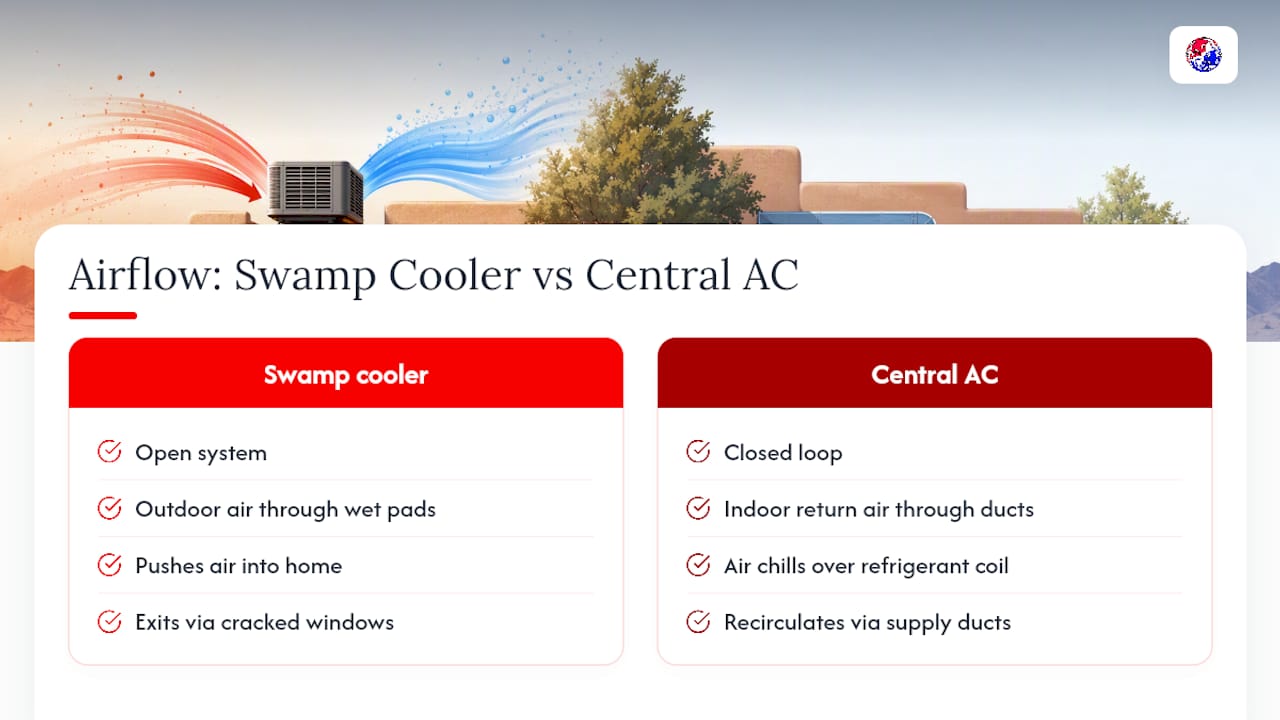
An evaporative cooler is an open system. It pulls hot outdoor air across water-soaked pads, cools it through evaporation, and pushes it into your home while a window or two stays cracked to let the air escape. Central AC works the opposite way: it's a closed loop that pulls indoor air through return ducts, chills it over a refrigerant coil, and recirculates it. No open windows, no constant air exchange with the outside.
That distinction drives almost everything about a conversion. Swamp coolers don't need return ductwork because the air just exits through open windows. Central AC absolutely does, and if your home was built or retrofitted around a cooler, there's a decent chance no return path exists at all. You'll also need to seal the roof or wall penetrations the old cooler left behind, since a sealed envelope is what makes refrigerated air efficient.
There's a real air-quality upside here too. A closed AC system lets you shut the house up tight and run filtration during wildfire smoke events, something an evaporative unit simply can't do since it's designed to draw in outside air continuously. For homeowners in dry, dusty, or smoke-prone regions, that alone is often the deciding factor.
Humidity control is the other common motivator. Swamp coolers add moisture to the air by design, which works fine in low humidity but turns sticky and uncomfortable during New Mexico's monsoon season. Central AC holds a consistent temperature and humidity level regardless of what's happening outside, which is part of why refrigerated air often outperforms evaporative cooling for homes that see hot, humid stretches even a few weeks a year.
How Much Does a Swamp Cooler to AC Conversion Cost?
Most homeowners pay somewhere between $2,500 and $12,000 for a complete swamp cooler to AC conversion, with the average landing near $6,000 for a standard 2.5-ton split system and moderate duct repairs, according to conversion cost data from Pick Comfort. Where you fall in that range depends almost entirely on duct condition, tonnage, and how much electrical work the job requires.
Here's what typically shows up on an itemized quote:
- Equipment: $3,000 to $7,000 depending on tonnage and SEER rating
- Ductwork modifications: $300 to $4,000, with cost rising sharply if new runs or return paths are needed
- Labor: $1,500 to $4,000 based on job complexity and local rates
- Permits and inspection: $150 to $500 in most jurisdictions
- Panel upgrade (if needed): $1,500 to $3,000
- Old cooler removal and disposal: $150 to $400
SEER rating is a bigger swing factor than most homeowners expect. Moving from a mid-efficiency unit to a high-efficiency one can add $800 to $2,000 in equipment cost alone, according to Design Transition Studio's cost breakdown. That's not a small line item, and it's worth deciding early whether long-term energy savings justify the upfront jump for your climate and usage pattern.
Three scenarios cover most of what we see on-site:
| Scenario | Typical Total | What's Included |
|---|---|---|
| Small-home mini-split swap | $2,500–$3,500 | No ductwork, single or dual-zone unit, minimal electrical work |
| Standard 2.5-ton conversion | $5,000–$7,000 | Duct sealing/repair, condenser and coil install, standard electrical hookup |
| Full replacement with new ducts | $9,000–$12,000+ | New duct runs, return air installation, likely panel upgrade |
Larger homes needing extensive duct redesign or multi-zone, high-SEER equipment can push past $20,000 in some markets, per Design Transition Studio's higher-end examples. That's the exception rather than the rule, but it explains why two quotes for the same house can look wildly different if one contractor is scoping a full duct overhaul and the other isn't.
Is Your Home Ready for the Switch?
Before you get quotes, walk your attic and electrical panel with a flashlight and a notepad. What you find changes the scope and the price significantly.
Duct compatibility checklist:
- Is there an existing return duct? Swamp coolers rarely have one, and its absence is the single biggest driver of added cost.
- Are supply ducts sized for central AC's lower airflow, or are they built for a cooler's much higher CFM output? Swamp cooler ductwork is often the wrong size and layout entirely, according to comparisons of swamp cooler and AC ductwork, which is a major reason mini-splits get recommended when ducts don't transfer over.
- Are existing ducts intact, or do you see gaps, disconnected joints, and crushed sections? Leaky ducts waste conditioned air and inflate utility bills long after installation.
Electrical checklist:
- What's your panel amperage? A 100-amp panel is common in older homes and often can't support a new condenser without an upgrade.
- Is there an open breaker slot for a dedicated 240-volt circuit? Central AC condensers need one.
- If you're at or near capacity, budget for a panel upgrade to 200 amps. That's a real cost, not a rare edge case.
Pro Tip: Don't let anyone size your system off square footage alone. A proper Manual J load calculation accounts for insulation, window placement, ceiling height, and local climate data. Skip it, and you risk an oversized unit that short-cycles and wears out early, or an undersized one that runs constantly and still can't keep up on the hottest days.
What Happens During Installation, Step by Step?
A conversion isn't one long chaotic day. It's a sequence, and understanding it helps you plan around the disruption.
- Pre-work: A technician evaluates your ducts, panel, and roofline, runs the Manual J calculation, and hands you a written itemized quote before anything gets touched.
- Removal: The swamp cooler comes off the roof or wall, and the water and electrical feeds get capped safely.
- Patching: The roof or wall opening gets sealed and patched to restore the building envelope.
- Outdoor unit placement: The condenser gets set on a pad or bracket outside.
- Indoor equipment: An indoor coil or air handler goes in, or mini-split units get mounted if you're going ductless.
- Refrigerant lines: Copper lines connect the outdoor condenser to the indoor coil, requiring careful routing and proper insulation to prevent efficiency loss.
- Duct work: Existing ducts get modified, sealed, or replaced, and a return path gets added if one didn't exist.
- Electrical hookup: The dedicated circuit gets wired in, with a panel upgrade completed first if needed.
- Commissioning and inspection: The system gets charged, tested, and signed off by a local inspector.
Timelines vary by scope. A single-zone mini-split can be done in a single day. A standard conversion with moderate duct work generally takes two to four days, according to installation timeline data from The Cooling Company. Full duct replacement stretches to three to seven days or longer, especially in larger homes.
Should You Go Full Central AC, or Consider a Hybrid Setup?
Full conversion isn't the only path. If your ducts aren't compatible or your budget is tight this year, a few alternatives are worth weighing.
- Ductless mini-splits skip ductwork entirely. A single-zone unit typically runs $2,500 to $3,500 installed, while a multi-zone setup covering several rooms lands higher depending on zone count.
- Hybrid setups keep the swamp cooler running on mild, dry days and add a mini-split or partial AC for the rest of the house. It costs less upfront but means maintaining two systems instead of one.
- Full central AC still wins for whole-house comfort, consistent filtration, and resale value. Buyers in most markets expect central air, and a functioning swamp cooler alone can be a sticking point during inspection.
If you're not ready to commit either way, keeping your swamp cooler well maintained as a backup buys you time to plan the bigger investment properly.
How Do You Get an Accurate, Comparable Bid?
Every contractor should hand you a quote broken into distinct line items: equipment model and SEER rating, labor hours, permit fees, electrical work, and disposal costs. If a quote arrives as one lump number, ask for the breakdown before you sign anything.
A few tactics keep costs reasonable without cutting corners:
- Choose a matched mid-efficiency system rather than chasing the highest SEER rating available; the payback period on premium efficiency doesn't always pencil out for moderate usage.
- Repair ducts instead of replacing them wholesale when they're structurally sound, just leaky or poorly sealed.
- Schedule the job during spring or fall. Off-season timing tends to lower labor rates and shorten permit wait times compared to peak summer demand.
Pro Tip: Ask every contractor three direct questions before you compare prices: Did you run a Manual J load calculation, or are you estimating by square footage? Who pulls the permit, you or them? What's your hourly labor rate if the job runs long? Vague answers to any of those are a red flag worth walking away from.
What Our Technicians Actually Find on These Jobs
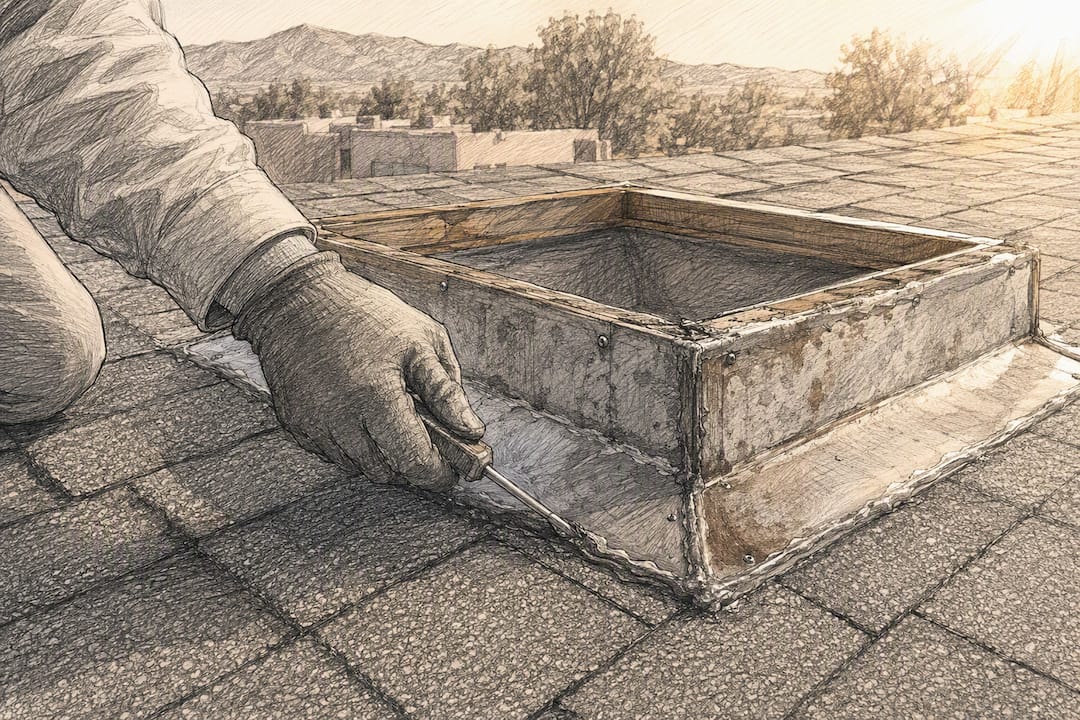
Every swamp cooler conversion we walk into in New Mexico has its own quirks, but a few problems show up again and again. Roof flashing around the old cooler mount is frequently degraded or improperly sealed from the original install, which means patching it right takes more than a tube of caulk. Old water supply lines running to the cooler are often corroded or brittle, and they need to come out completely rather than just get capped. And in probably half the homes we inspect, there's no return air path at all, which means duct work isn't optional if you're going central.
Our approach on every estimate is the same: a real technician walks the property, runs the numbers, and hands you an itemized scope in writing. No automated call centers, no vague ballpark guesses. We've spent 37-plus years working on HVAC systems across New Mexico's climate, and that means we've seen almost every duct layout and panel configuration a swamp cooler retrofit can throw at us. We also handle the permitting conversation directly with you, so there's no confusion about who's responsible for what before work starts.
The Gap Between a Good Estimate and a Good Installation
Here's what most cost guides get wrong: they treat the estimate as the hard part and the installation as a formality. In practice, it's the reverse. A contractor who skips the Manual J calculation and eyeballs your tonnage off square footage alone can hand you a number that looks great on paper and still leaves you with a system that short-cycles for the next fifteen years. The estimate is where corners get cut invisibly, because the homeowner has no way to check the math until the unit is already running.
The other underestimated factor is duct honesty. It's tempting for a contractor to quote the cheaper "duct sealing" line item when the real fix is a partial duct replacement, because sealing wins the bid. You won't find out until your energy bills come in higher than expected or a room never quite cools down. Ask specifically whether your quote assumes your existing ducts are reusable as-is, repaired, or replaced, and get that assumption in writing.
If there's one piece of conventional wisdom worth pushing back on, it's the idea that the cheapest quote is the safer bet in a dry climate. In New Mexico's heat and altitude, an undersized or poorly ducted system doesn't just run inefficiently. It struggles constantly, and that struggle shows up in your utility bill every single month for as long as you own the house.
— Aaron Waller - GM
Ready to Get a Real Number for Your Home?
If you've read this far, you already know the range. What you don't know yet is where your specific home lands in it, and that's the part a cost guide can't tell you. A technician visits your property to inspect your ducts, check your panel capacity, and run the actual Manual J calculation before you get a number.
What you get back is a written, itemized estimate covering equipment, labor, permits, and any electrical work, along with a realistic timeline for your specific job, whether that's a one-day mini-split install or a full multi-day conversion with new ductwork. The permit process is handled directly to avoid leaving you to navigate it alone. If you're planning ahead, scheduling your swamp cooler to AC conversion in the spring before peak summer demand hits is one of the simplest ways to control both cost and wait time. Reach out with your home's square footage, current panel size, and whether you already have any ductwork in place, and we'll get an estimate scheduled.
Sources
- Swamp cooler to AC conversion cost estimates and typical pricing 2026 - Pick Comfort
- Swamp Cooler to AC Conversion Cost Guide 2026 – Design Transition Studio
- Swamp Cooler to Central AC Las Vegas: Cost & Conversion Guide | The Cooling Company
- Swamp cooler vs AC vs heat pump
FAQ
Can I Replace My Swamp Cooler With an Air Conditioner?
Yes, in nearly all homes. The main considerations are whether your existing ductwork can support central AC's return air needs and whether your electrical panel has capacity for a new condenser circuit.
How Much Does It Cost to Convert a Swamp Cooler to Central AC?
Most conversions cost between $2,500 and $12,000, with a standard 2.5-ton system and moderate duct repairs averaging around $6,000. Full replacements requiring new ductwork or a panel upgrade often run $9,000 or more.
What Is the $5,000 Rule for AC?
Definitions of this rule vary by contractor and region, and this article doesn't cover a specific $5,000 threshold rule. If you've heard this term from a quote, ask the contractor directly what number and logic it's based on before relying on it.
Is It Cheaper to Run a Swamp Cooler or AC?
Swamp coolers generally cost less to operate in dry climates because evaporative cooling uses less electricity than compressor-based refrigeration, but they use significantly more water and lose their efficiency advantage once humidity rises during monsoon season.