
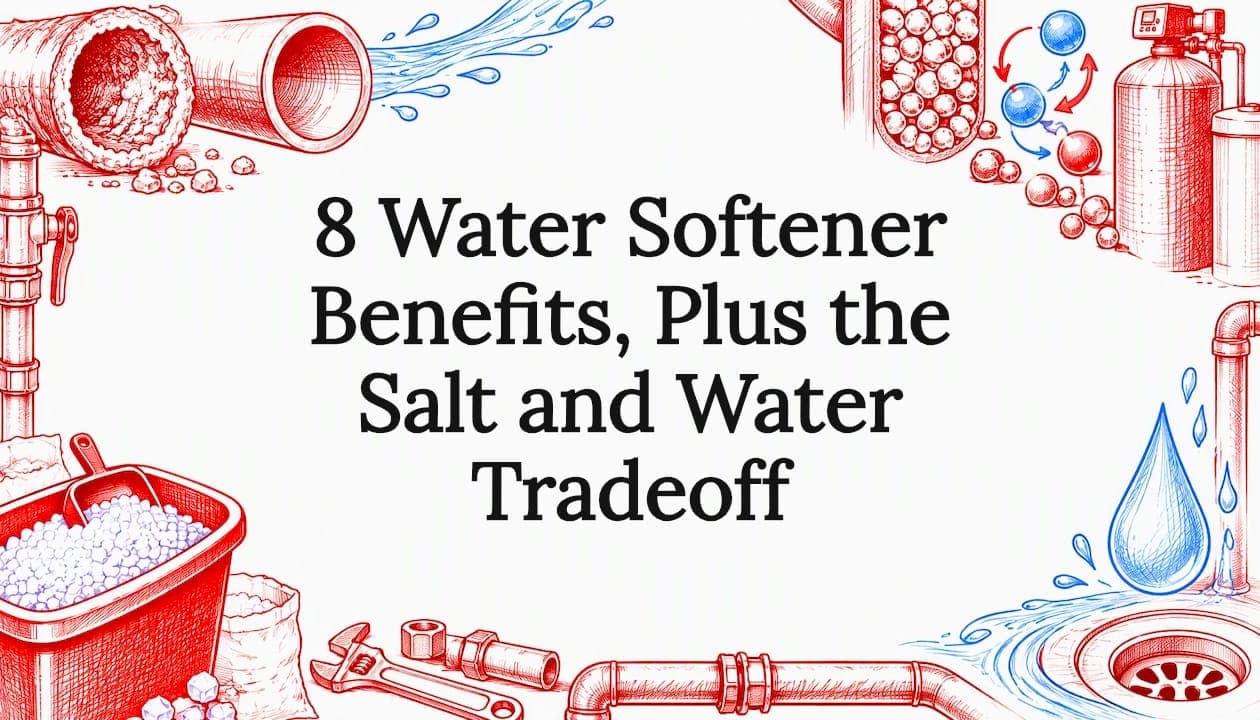
A water softener removes the hardness minerals that cause scale, so you get easier cleaning, less soap use, softer-feeling bathing, and appliances that tend to last longer. The tradeoff is salt and the water used during regeneration, which we cover in the maintenance section. EPA WaterSense guidance and the NSF/ANSI 44 efficiency rating help you pick a smart system, and our team at Waller's Plumbing and Heating, Inc. can walk you through it.
TL;DR:
- Confirm hardness through a laboratory certified by the state: levels above about 120 mg/L, or roughly 7 gpg, are generally considered hard.
- Choose a model that regenerates on demand and carries an NSF/ANSI 44 efficiency rating; it reduces salt and water waste compared with scheduled systems.
- Regeneration can use 25 gallons or more daily and up to about 10,000 gallons yearly, so plan the discharge carefully, especially with a septic system.
- Energy savings are most likely when water is very hard or the heater already has scale; mildly hard water may produce little savings.
- Soft water can leave skin feeling slippery, and reported improvements are not guaranteed; people with eczema or sensitive skin should consult a healthcare professional.
Table of Contents
- Which water softener benefits can you expect at home?
- How does soft water protect your plumbing and appliances?
- Can a softener lower your energy and utility costs?
- Do you really use less detergent and get cleaner dishes?
- What happens to your skin and hair?
- Will soft water make daily life easier around the house?
- What does maintenance involve, and how do you keep water and salt use low?
- How can you tell if you have hard water?
- What should you expect after your softener is installed?
- What do we tell homeowners who ask about softeners?
- How can Waller's Plumbing and Heating help you with a softener?
- FAQ
- Sources
Which water softener benefits can you expect at home?
Here is the short version of what a softener changes in your house, with a pointer to the section that covers each one.
- Plumbing and appliance protection: less scale on heating elements, pipes, and valves (see the plumbing section).
- Energy and utility costs: a cleaner water heater works with less wasted effort (see the energy section).
- Cleaning, laundry, and dishes: better lather and fewer residues (see the cleaning section).
- Skin and hair: easier rinsing and a softer feel (see the skin and hair section).
- Household convenience: fewer spots, clogs, and scrubbing sessions (see the convenience section).
- Maintenance and environment: salt, regeneration water, and how to keep both low (see the maintenance section).
- Knowing you need one: visible signs and reliable tests (see the hard water section).
- Life after installation: what changes right away and what takes months (see the expectations section).
How does soft water protect your plumbing and appliances?
Hard water carries dissolved calcium and magnesium. USGS explains that these minerals create the effects we call hard water. When that water heats up or sits in a fixture, the minerals come out of solution and harden into scale.
An ion exchange softener swaps those hardness minerals for sodium or potassium as water passes through resin beads. NDSU Agriculture describes ion exchange as the established approach for removing hardness. Without the minerals, scale has nothing to build from.
Scale acts like insulation. A crust on a water heater element or tank bottom makes the heater work harder to move heat into the water, and it narrows pipes and clogs valves. Washing machines and dishwashers face the same buildup on their heating parts and spray arms, which means more service calls over time. Our team covers related care in our guide to extending the life of your water heater.
Signs that scale is easing up:
- Faucets and showerheads stay clear longer between cleanings
- Your water heater runs quieter, with less popping or rumbling
- Dishwasher and washer interiors stay cleaner
- Fewer white crusts form around valves and fittings
Cation exchange works where other devices struggle.** In a standardized test protocol study, cation exchange significantly reduced scaling, while some alternative devices reduced it far less. Magnetic and similar gadgets are a risky substitute.
Next step: look at your heater and faucets, and if you see crust, test your water before shopping.
Can a softener lower your energy and utility costs?
Often, but not in every home. Scale on a heating element slows heat transfer, so a scaled water heater uses more energy to deliver the same hot water. Removing the source of scale protects that efficiency. The Department of Energy's purchasing and maintenance guidance shows how regeneration and efficiency shape what a softener costs to run, so savings depend on the model you choose.
Recurring costs to budget for:
- Salt (or potassium) for the brine tank
- Water used each time the system regenerates
- Occasional service and resin care
- A little electricity for the control valve
Efficiency changes this math. Demand-initiated regeneration (DIR) cleans the resin only when it is used up, while older time-initiated units regenerate on a schedule whether or not they need to. The WaterSense technical sheet says DIR is more efficient than time-initiated systems, and NSF/ANSI 44 includes a voluntary efficiency rating you can compare.
Efficiency is the lever you control.** Per the WaterSense technical sheet, demand-initiated regeneration beats time-initiated regeneration on efficiency, so it lowers salt and water waste.
Payback is most likely in homes with very hard water or a heater that is already scaled. If your water is only mildly hard, the savings may be small.
Pro Tip: Size the unit to your household's hardness and water use, and favor a DIR model with an NSF/ANSI 44 efficiency rating.
Do you really use less detergent and get cleaner dishes?
Yes, in most homes. Hard minerals bind with soap and detergent, which cuts lather and leaves a film behind. That film shows up as soap scum in the tub, gray-looking laundry, and cloudy glasses.
Soft water lets soap do its job, so you notice a handful of changes:
- Less detergent, soap, and shampoo needed for the same lather
- Laundry that looks brighter and feels less stiff
- Glassware and dishes that dry with fewer spots
- Shower doors, sinks, and fixtures that wipe clean faster
- Less time scrubbing mineral crust and soap scum
A few easy habits help. Start by adjusting your detergent and see how clothes and dishes turn out. Because soft water rinses so easily, you may find that a normal cycle works fine where you once reached for extra rinses. We would rather not prescribe exact amounts, since your water, your machines, and your products all differ, so go by results. If you are chasing stains already on your fixtures, our hard water stain removal tips cover what to do first.
What happens to your skin and hair?
Many homeowners report a noticeable difference in the shower. These are common reports, not guarantees:
- Soap and shampoo rinse out more easily
- Skin feels softer and less tight after bathing
- Hair looks shinier and feels less coated
- Less residue lingers on your body and in the tub
A softener is generally used to address hardness and its effects around the home, not as a medical treatment. If you have eczema, very sensitive skin, or another skin condition, talk with a healthcare professional rather than counting on a softener to fix it. Soft water can also feel slippery at first, which is just the absence of mineral film.
Small routine changes tend to follow. Most people use less soap and shampoo once they notice how little it takes to lather, and some find they can skip an extra rinse. That alone trims how much product you buy.
Will soft water make daily life easier around the house?
It cuts down the small, repeated chores. Scale builds up in aerators, showerheads, and tap openings, which narrows the flow and sends water in odd directions. Soft water slows that buildup, so fixtures stay clear and spotting drops on glass, mirrors, and chrome.
Improvements you can watch for:
- Fewer white spots on shower glass and faucets
- Steadier flow from showerheads and taps
- Fewer clogged aerators and spray holes
- Less frequent descaling of the kettle, coffee maker, and fixtures
- Faster wipe-downs of counters and tubs
You will likely spend a lot less time descaling and scrubbing, though how much depends on how hard your water was to begin with. One quick tip: if buildup lingers on an aerator, unscrew it, soak it in vinegar, and rinse it. That clears what scale left behind.
What does maintenance involve, and how do you keep water and salt use low?
A softener is low effort, but it is not zero effort. During regeneration the system flushes brine through the resin and sends wastewater down the drain. EPA states that regeneration can use 25 gallons or more per day and up to about 10,000 gallons per year, so you should plan where that discharge goes, especially with a septic system.

Salt efficiency matters too. Higher-efficiency units use less salt, which also means less sodium and chloride heading to wastewater. EPA's guide to selecting a water-efficient softener explains that softeners can consume a lot of water and salt in regeneration, and that choosing efficient models and running them properly limits the waste.
Plan for the discharge.** EPA notes that regeneration can use up to about 10,000 gallons per year, so efficient models and a smart drain plan protect your septic system and your water bill.
Ways to keep waste down:
- Bypass outdoor lines so you do not soften water for lawns and hoses
- Size the unit to your actual hardness and household use
- Choose a DIR model over a time-initiated one
- Check the salt level regularly and use the salt type your manufacturer recommends
- Plan wastewater discharge carefully if you have a septic system
Pro Tip: Have your water tested by a state-certified lab before you buy, and skip time-initiated regeneration models.
How can you tell if you have hard water?
Your home usually tells you first. Look for:
- White spots on dishes, glasses, and shower doors
- Scale crust on faucets and showerheads
- Soap scum that returns quickly
- Dry-feeling skin or dull hair after bathing
- A water heater that seems to work harder than it should
For a quick home check, fill a clear bottle with tap water, add liquid soap, and shake. Thick suds with clear water suggest soft water, while weak suds and cloudy water point to hard water. It is a hint, not a measurement.
For a real number, check your local water quality report or use a state-certified laboratory, which gives hardness in grains per gallon (gpg) or milligrams per liter (mg/L). Per the WaterSense technical sheet, hardness above about 120 mg/L (roughly 7 gpg) is generally considered hard and often benefits from softening. A softener may be worth considering when hardness is high. The right choice depends on your water and household needs. If you are also weighing filtration, see our comparison of whole house and drinking water filters.
What should you expect after your softener is installed?
Some benefits may show up soon after installation, while others take longer.
- After installation: soap may lather more easily, showers may feel different, and new spotting may drop.
- With ongoing use: fixtures and glassware may stay cleaner, and you may use less detergent.
- Over time: appliance and energy benefits may build, depending on how much scale existed before. Existing scale does not vanish overnight.
- Ongoing: budget for salt and occasional service. DIR and a good salt-efficiency rating keep those costs lower.
Before you install, run through this checklist: test your water, size the unit by grain capacity, and consider a bypass for outdoor lines. If you are considering a partial setup, ask a professional about it first, since your goals and your plumbing both matter.
What do we tell homeowners who ask about softeners?
Most people who call us ask the same thing: "Do I actually need one?" Our answer is to test first. In our field installs, the homes that get the most from a softener are the ones that measured their hardness, sized the system properly, and chose a demand-initiated model. We also push for a bypass on outdoor lines, because softening water for the garden is just wasted salt. A softener should fit the house, not the other way around.
How can Waller's Plumbing and Heating help you with a softener?
If you are ready to move from reading to doing, we can take care of the whole job. Our team handles:
- Home water quality assessments
- Water softener installation
- Hard water treatment
- Ongoing service and maintenance
Professional sizing helps match a softener to your home. A properly sized install can help limit salt and water waste, and you talk directly to a local expert, not a phone menu. We leave your home clean, too.
Ready to find out where your water stands? Schedule a home water quality assessment with us and we will help you decide what fits your home.
FAQ
What are the benefits of a water softener?
A softener reduces scale, which helps protect pipes, water heaters, and appliances. You also get easier cleaning, better lather, spot-free dishes, and softer-feeling bathing. Savings depend on how hard your water is.
What are the downsides of a water softener?
The main considerations are the salt it uses and the water used during regeneration. EPA says regeneration can use 25 gallons or more per day. Choosing a demand-initiated, salt-efficient model keeps that use lower.
Are water softeners good for health?
A softener is generally used to address hardness and its effects around the home, rather than as a medical treatment. If you have a skin condition or a medical concern, check with a healthcare professional first.
How do I know if I need a water softener?
Look for spotting, scale on fixtures, and soap scum, then confirm with a test. Hardness above about 7 gpg is generally considered hard, per the WaterSense technical sheet.
Sources
- Water Softening (Ion Exchange) | NDSU Agriculture
- WaterSense Labeled Homes Technical Sheet: Water Softeners